

Metal roofs are common across Asia in factories, warehouses, logistics facilities, transport buildings, showrooms, commercial buildings and industrial sites. They are strong, lightweight and practical for large roof areas. But when metal roof leaks start, the first repair is often very simple: “Apply sealant.”
Sometimes this works for a small, isolated issue.
But when the same metal roof keeps leaking again and again, especially around seams, flashings, gutters, fasteners, penetrations, skylights or ventilation points, sealant alone is often not enough.
In many projects across Asia, the problem is not that the sealant was applied badly. The problem is that the roof detail is moving, exposed, wet, hot, vibrating, corroding or poorly prepared - and the sealant was expected to do the job of a complete waterproofing system.
This article explains why metal roof sealants fail, why this issue is especially relevant in tropical and high-rainfall climates, and how Triflex Asia supports long-term metal roof waterproofing with systems such as Triflex ProDetail and Triflex Metal Coat.
Quick Answer: Why Do Metal Roof Sealants Fail?
Metal roof sealants fail when they cannot handle the real site conditions. Common causes include thermal expansion and contraction, UV exposure, heavy rain, high humidity, poor surface preparation, corrosion, vibration, incompatible materials, weak adhesion, ponding water and movement at joints or penetrations. Sealants are often useful as part of a correctly designed detail, but they usually fail when used as a simple surface patch over a moving or deteriorated metal roof area.
Why Metal Roof Waterproofing Is Different
A metal roof does not behave like a concrete roof. Metal panels expand when they heat up and contract when they cool down. In Asia, this cycle can happen every day: strong sun during the day, heavy rain or cooling later, then heat again the next morning. That repeated movement affects the weakest points of the roof.
These are usually:
Sheet overlaps
Standing seams
End laps
Hip and ridge flashings
Gutters
Drainage channels
Roof penetrations
Ventilation points
HVAC bases
Skylight or glass interfaces
Fasteners and screw points
Cut edges
Corroded areas
Previous repair zones
The metal sheet may still be structurally sound, but the waterproofing detail around it may not be. That is why a metal roof leak should not be treated only as a hole to fill. It should be treated as a movement, adhesion and detailing problem.
Why This Matters in Asia
Metal roofs in Singapore, Thailand, Malaysia, Hong Kong, Vietnam and other APAC markets face demanding conditions.
They are exposed to:
Heavy seasonal rain
High humidity
Strong UV exposure
Heat build-up on metal surfaces
Rapid temperature changes
Wind-driven rain
Coastal or polluted environments
Corrosion risks
Mechanical vibration from ventilation systems or equipment
Limited maintenance access
Pressure to keep buildings operating during repairs
In Singapore, the climate is hot, humid and rainy throughout the year. In Hong Kong, most rainfall occurs in the warmer months, often together with tropical cyclones, monsoon conditions and thunderstorms.
For building owners and facility teams, this means one thing: a quick sealant repair may stop visible water ingress for a short time, but it may not survive the full combination of heat, moisture, movement and exposure.
This is especially important for operational buildings such as factories, airports, schools, malls, car showrooms and warehouses where leaks can affect business continuity, safety, customer experience and maintenance budgets.
1. Sealants Fail Because Metal Roofs Move
Thermal movement is one of the main reasons metal roof sealants fail. Metal sheets expand and contract as temperatures change. This movement can be small, but it happens repeatedly over months and years.
When a sealant bead is applied over a joint, lap or flashing without enough reinforcement or correct joint design, it may eventually:
Stretch beyond its limit
Tear at the edges
Lose adhesion
Split in the middle
Pull away from one side of the metal
Allow water to enter behind it
The issue becomes worse when the repair is placed over a joint where two materials move differently, such as metal-to-glass, metal-to-concrete, metal-to-flashing or metal-to-equipment base interfaces.
This is why sealants often fail at metal roof details, even when the roof surface itself looks fine.
2. UV Exposure Can Degrade Exposed Sealants
Many sealants are designed to work in specific conditions. Some are intended to be protected within a lap joint or flashing assembly. Others are exposed to sunlight, rain and weather. When the wrong sealant is used in an exposed area, UV exposure can gradually make it harder, more brittle or less elastic. Over time, this can lead to cracking, shrinkage and joint failure. In Asia, this is a major concern because metal roofs are often exposed to strong sunlight for long periods. The roof heats up. The sealant softens, hardens, stretches or shrinks depending on the material. Then rain comes. Then the roof heats again. This repeated cycle makes exposed sealant repairs difficult to rely on as a long-term waterproofing solution.
3. Poor Surface Preparation Reduces Adhesion
A sealant is only as good as the surface it bonds to.
Metal roofs can be difficult because the surface may contain:
Dust
Oil
Grease
Manufacturing residue
Rust
Oxidation
Old coating
Loose paint
Old sealant
Moisture
Cleaning chemical residue
Dirt trapped in seams or fastener lines
If the surface is not prepared properly, the sealant may bond to dirt, rust or failed coating instead of the metal itself. The repair may look complete on the day of installation, but the bond can fail later when the roof moves, gets wet or heats up.
This is one reason repeated metal roof patch repairs often fail. The new layer is not solving the actual substrate condition. It is only covering the previous failed repair.
For projects where the surface condition is uncertain, technical specification support can help assess the substrate, adhesion requirements and suitable system build-up before another repair is approved.
4. Moisture and Humidity Can Compromise Repairs
In tropical climates, the surface may look dry but still be affected by moisture, condensation or humidity. This matters because many sealants and coatings need suitable application conditions to achieve proper adhesion and curing.
If moisture is trapped under the repair, it can create future problems such as:
Blistering
Debonding
Poor curing
Corrosion beneath the coating
Loss of adhesion
Water migration under the repair area
For metal roofs, this becomes especially risky around overlaps, drainage channels, gutters and penetrations where water can stay hidden. A waterproofing repair should not begin only with applying material. It should begin with checking whether the surface is clean, dry, stable and suitable for the selected system.
5. Corrosion Changes the Problem
Rust is not only a visual issue. Once corrosion starts, the metal surface becomes weaker and more difficult to bond to. A sealant applied over corrosion may not create a reliable long-term seal because the surface underneath is already deteriorating.
Common corrosion-related problems include:
Rust under old coatings
Blistering or flaking paint
Cut-edge corrosion
Corrosion around fasteners
Corrosion at drainage points
Rust spreading from scratches or dents
Poor adhesion over oxidised surfaces
If corrosion is already present, the project may need more than a sealant repair. The damaged or unsound coating must be assessed, loose corrosion must be removed, and the roof may need a suitable corrosion protection system.
This is where Triflex Metal Coat can be relevant for metal roof refurbishment. It is designed as a functional coating for metal roofs, helping protect against corrosion and extend the service life of metal roof structures.
6. Vibration and Equipment Movement Can Break the Seal
Metal roofs are often used on buildings with ventilation systems, exhaust points, mechanical equipment or roof-mounted services. These areas create additional stress. A sealant around a ventilation penetration may not only be exposed to water and heat. It may also be exposed to vibration. Over time, vibration can weaken the bond between the sealant and the metal surface, especially if the detail was not reinforced or the sealant had limited movement capacity.
This was one of the issues seen in Triflex Asia’s Tuas factory reference in Singapore, where standard sealant failed over time due to metal roof expansion and ventilation vibration.
For these areas, the waterproofing solution needs to accommodate both roof movement and service-related movement.
7. “More Sealant” Is Not Always Better
When a leak returns, it is common to add more sealant. But adding more material does not always solve the problem. In some cases, it makes the detail thicker, messier and harder to inspect. It can also trap water, hide corrosion, or create stress at the edge of the repair.
The real question is not: “How much sealant should we apply?”
The better question is: “Why did the previous sealant fail?”
If the answer is movement, poor adhesion, UV exposure, trapped moisture, corrosion, vibration or wrong system selection, then more sealant will likely repeat the same failure.
8. The Leak Source May Not Be Where Water Appears
Metal roofs can move water in unexpected ways. A ceiling stain may appear below one area, but the water may have entered several metres away through a lap, penetration, ridge flashing or drainage channel.
This happens because water can travel along:
Metal ribs
Sheet overlaps
Fastener lines
Insulation layers
Flashing details
Structural framing
Existing failed repair layers
That is why visual patching often fails. The visible leak is only the symptom. The source may be higher up, further along the roof slope or hidden behind an interface.
For metal roof waterproofing, proper inspection is essential.
Common Metal Roof Leak Points to Check
Before approving another sealant repair, check these areas carefully:
1. Fasteners and washers
Exposed fasteners can loosen, age or lose compression. Washers can harden, crack or lose watertightness.
2. Sheet laps and seams
Side laps, end laps and standing seams can open slightly due to movement, installation issues or ageing.
3. Flashings
Hip flashings, ridge flashings, edge flashings and wall flashings are common leakage points.
4. Penetrations
Ventilation pipes, exhaust units, skylights, hatches and equipment bases are high-risk areas because they interrupt the roof surface.
5. Gutters and drainage channels
Water concentration increases the pressure on joints, outlets and seams.
6. Glass and metal interfaces
Glass roofs, canopies and skylights require careful detail waterproofing because different materials move differently.
7. Previous repair areas
Old sealant, patch repairs and incompatible coatings may hide the real failure.
When Is Sealant Enough?
Sealant can be suitable when the problem is small, isolated, compatible with the substrate, and part of a correctly designed joint or detail.
For example, sealant may be appropriate when:
The substrate is clean, dry and sound
The joint is designed for sealant use
The material is compatible with the metal surface
Movement is limited and understood
The repair area is protected
The correct application method is followed
The manufacturer’s recommendations are met
But sealant alone is usually not enough when:
The same leak keeps returning
The roof detail moves significantly
There is corrosion or loose coating
The area is exposed to strong UV and rain
There are multiple materials meeting in one detail
The roof has complex penetrations
The repair area is damp or contaminated
Previous sealants have already failed
The area needs long-term waterproofing protection
In these cases, the project may need a reinforced liquid-applied waterproofing system instead of another surface patch.
Sealant Repair vs Reinforced Waterproofing System
| Project Situation | Sealant Repair | Reinforced Waterproofing System |
|---|---|---|
| Small isolated joint | May be suitable | May not be necessary |
| Recurring leak | Often temporary | Better option for root-cause repair |
| Moving metal detail | Limited performance if not designed correctly | Designed to accommodate movement |
| Complex penetration | Difficult to seal long term | Adapts around shape and detail |
| UV-exposed repair | Depends on sealant type | Full surface protection possible |
| Corroded metal | Not enough without preparation | Can be part of refurbishment build-up |
| Operational building | May need repeated maintenance | Fast-curing systems can reduce disruption |
| Long-term waterproofing goal | Limited if used alone | More suitable for complete protection |
How Triflex ProDetail Helps With Metal Roof Details
Triflex ProDetail is a cold liquid-applied waterproofing system developed for joints, details and complex roof areas.
For metal roof waterproofing, it is especially relevant around:
Flashings
Gutters
Roof penetrations
Skylights
Glass interfaces
Access hatches
Ventilation points
Metal seams
Upstands
Edges
Difficult geometries
Areas where previous sealant repairs failed
Because it is liquid-applied, it can adapt to irregular shapes and difficult details.
Because it is reinforced, it supports crack-bridging and movement accommodation.
Because it cures to a seamless surface, it avoids the weak points created by joints, seams and separate patch pieces.
Triflex ProDetail is also fast curing, which is important for operational buildings where long closure periods are not practical.
How Triflex Metal Coat Supports Metal Roof Refurbishment
When the issue is not only a leaking detail but also surface aging or corrosion risk, Triflex Metal Coat may be relevant.
Triflex Metal Coat is a functional coating developed for metal roofs. It helps protect against corrosion and prolongs the life of metal roof structures. It is especially useful for refurbishment because the system has a low added weight, which helps avoid unnecessary load on the roof structure. For a complete metal roof refurbishment approach, Triflex Metal Coat can be used together with Triflex ProDetail for the joints, overlaps and critical details. This matters because the open metal roof surface and the detail areas do not fail in the same way. The surface may need corrosion protection. The joints and details may need reinforced waterproofing. A proper metal roof solution should consider both.
APAC Project Examples: Where Sealants Failed
Triflex Asia has several references where metal roof leaks were not solved by standard sealants or traditional repairs.
Metal roof hip flashing in Thailand

At a factory roof project in Udon Thani, leaking occurred at the interface between the hip flashing and the metal roof. Previous standard sealant repairs failed within months because of metal roof expansion and contraction. Triflex ProDetail was selected to provide a seamless, flexible, reinforced waterproofing solution that could accommodate movement.
Airport metal roof in Bangkok

At MJET Don Mueang Airport, the problem was at the joint interfaces between the metal roof and new window access points. A previous standard sealant attempt was ineffective because the metal roof expanded and contracted. Triflex ProDetail was used to waterproof the interface with a reinforced system while minimizing disruption to airport operations.
Factory roof penetrations in Singapore
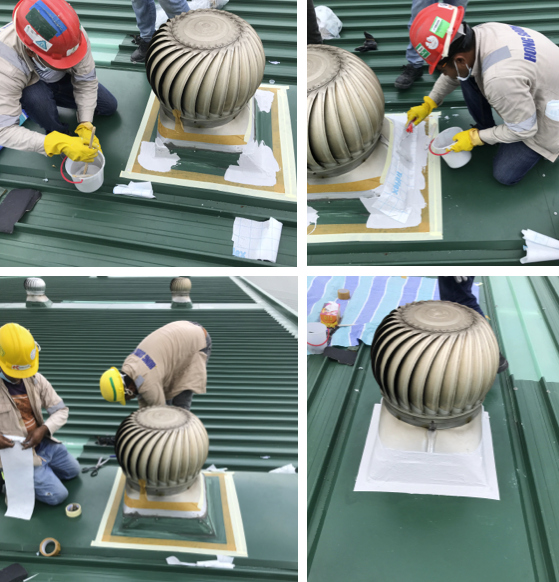
At a factory in Tuas, Singapore, 27 ventilation penetrations on a new metal roof needed effective waterproofing. Standard sealant had failed over time because of roof expansion and vibration from the ventilation system. Triflex ProDetail was selected to provide a stronger detail waterproofing solution.
Curved metal roof at a car showroom in Thailand

At Honda Udon Thani, the curved metal roof had recurring leaks despite multiple attempts using metal flashing and sealants. The problem involved curved surfaces, penetrations, joints, limited flexibility, poor adhesion and seasonal heavy rain. Triflex ProDetail was selected for its crack-bridging ability, full-surface adhesion, durability and adaptability to difficult details.
Metro metal roof in Bangkok

At the BTS Gold Line Metro project, waterproofing was required at the interface between the existing MRT roof and new access hatch windows. The challenge involved metal roof movement and proper rainwater drainage. Triflex ProDetail was selected to waterproof the interface and accommodate expansion and contraction.
What to Check Before Repairing a Metal Roof Leak
Before choosing another sealant repair, ask these questions:
Where is the water entering?
Is the visible leak directly below the source?
Is the leak at a seam, flashing, penetration, gutter or fastener line?
Is the metal surface corroded, oxidised or contaminated?
Is the old coating still bonded?
Has the previous sealant failed?
Is the roof exposed to strong UV and heat?
Does the area experience movement or vibration?
Is water ponding or being pushed toward the detail?
Are different materials meeting at the leak point?
Is the substrate dry enough for the selected system?
Does the building need to remain operational during repair?
Is this a temporary patch or a long-term waterproofing solution?
If several of these questions raise concern, a sealant-only repair may not be the right approach.
The Real Cost of Repeated Sealant Repairs
Sealant patching may seem cost-effective at first.
But repeated repairs can become expensive when they lead to:
More labour visits
More inspection time
More disruption to operations
Ceiling and interior damage
Corrosion spreading under the repair
Customer, tenant or staff complaints
Safety concerns from water ingress
More difficult future refurbishment
Loss of trust in the repair method
For commercial and industrial buildings, the real cost is often not the material. It is the repeated disruption. This is why metal roof waterproofing should be assessed properly from the start.
Recommended Approach for Metal Roof Waterproofing in Asia
For metal roofs in APAC climates, the best approach is usually not to ask: “What sealant should we use?”
The better question is: “What is the failure mechanism?”
A proper review should consider:
Roof movement
Joint design
Substrate condition
Surface contamination
Corrosion level
UV exposure
Rainwater flow
Drainage
Vibration
Existing repairs
Compatibility
Access and downtime
Long-term maintenance needs
From there, the repair can be matched to the real problem.
For isolated details, Triflex ProDetail may be suitable.
For larger metal roof refurbishment and corrosion protection, Triflex Metal Coat may be part of the solution.
For broader roof waterproofing needs, Triflex ProTect and other roof systems may also be considered depending on the project condition.
FAQ: Metal Roof Waterproofing and Sealant Failure
Why do metal roof sealants fail?
Metal roof sealants fail when they cannot handle movement, UV exposure, moisture, poor adhesion, corrosion, vibration or incompatible substrates. They often fail at seams, flashings, penetrations, fasteners and interfaces where movement and water concentration are highest.
Is silicone enough to stop a metal roof leak?
Silicone may be suitable for some specific applications, but it is not automatically the right solution for every metal roof leak. The correct repair depends on the substrate, movement, exposure, compatibility and whether the leak is isolated or recurring.
Can a metal roof be waterproofed without replacement?
Yes, in many cases a metal roof can be refurbished instead of replaced if the substrate is still structurally sound. The roof should be inspected first to check corrosion, adhesion, previous repairs, drainage and movement.
Why do metal roof leaks keep coming back?
Metal roof leaks return when the repair treats only the visible gap instead of the cause. Common causes include roof expansion and contraction, weak flashings, poor adhesion, corroded surfaces, vibration, drainage problems and repeated patch repairs.
What is the best waterproofing system for metal roof details?
The best system depends on the project, but for joints, flashings, penetrations and complex metal roof details, a reinforced liquid-applied system such as Triflex ProDetail can provide a seamless, flexible waterproofing layer that adapts to difficult shapes and movement.
What is Triflex Metal Coat used for?
Triflex Metal Coat is used as a functional coating for metal roof refurbishment. It helps protect metal roof surfaces against corrosion and can be used together with Triflex ProDetail for joints, overlaps and details.
When should I request a technical review?
You should request a technical review if the metal roof has recurring leaks, failed sealant repairs, corrosion, movement cracks, ponding water, difficult penetrations, leaking flashings, or a repair area that must be completed with limited downtime.
Conclusion
Sealants have a place in metal roof construction and repair. But when a metal roof keeps leaking, another bead of sealant is rarely the full answer.
In Asia, metal roofs face heat, heavy rain, humidity, UV exposure, movement, vibration and corrosion risk. These conditions put pressure on every lap, flashing, fastener, penetration and drainage detail. If the repair cannot accommodate those conditions, the leak may return.
Triflex Asia supports metal roof waterproofing and refurbishment with liquid-applied systems designed for complex roof details, movement and long-term protection.
If your metal roof has recurring leaks, failed sealant repairs or early corrosion, speak with Triflex Asia before planning the next patch.
Dealing with metal roof leaks in Singapore, Thailand, Malaysia, Hong Kong, Vietnam or across APAC?
Ask Triflex Asia for a project-specific metal roof waterproofing recommendation.
Share your roof photos, leak location, existing repair history and project requirements so the Triflex team can help review the right solution.